 EN
Home Skincare
Ideal for daily facial care routines, providing easy-to-use beauty solutions at home.

2026/10/25
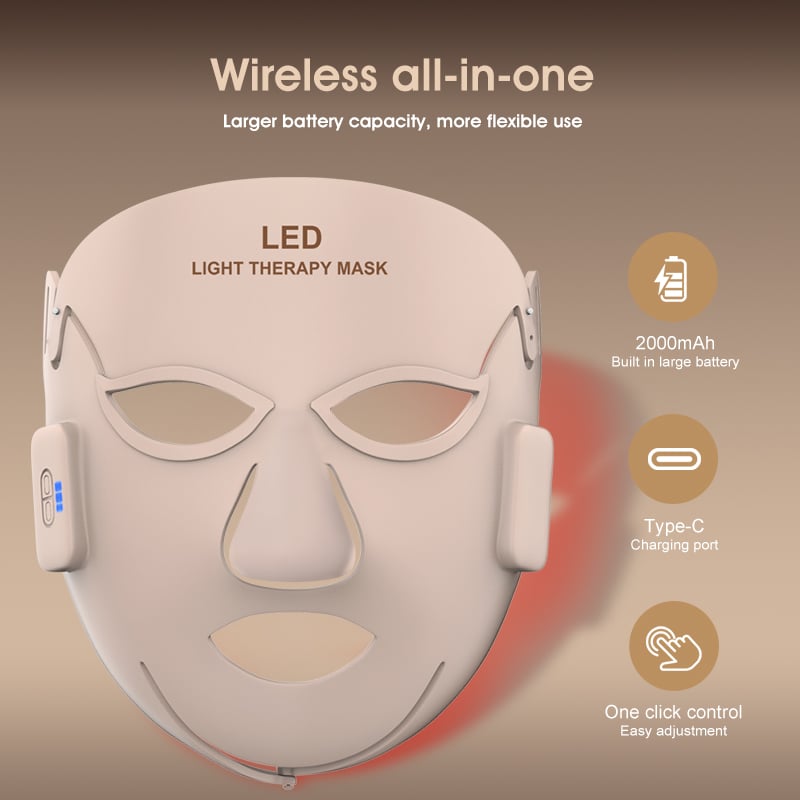
For a brand choosing an LED facial device, the silicone mask versus ABS question is not really a contest between “soft” and “hard.” It is a product-life decision. The face-contact layer, LED carrier, straps, seams, controller connection, cleaning routine, packaging, and batch consistency all affect whether a mask still feels presentable after repeated sessions. From a brand buyer’s perspective, a lower tooling cost can be attractive, but a material choice that produces fit complaints, visible aging, or difficult cleaning can cost more in returns and support later.
In most close-fitting LED applications, a silicone mask is usually the stronger starting point for long-term user-facing durability because it can flex with the face and generally tolerates repeated bending well. An ABS plastic mask can remain durable too, particularly when its shell geometry, wall thickness, finish, and assembly are engineered and validated well. The right answer depends on which part of the device is being evaluated and how the finished product will be used.
“Durable” is often used too loosely in product briefs. For an LED mask, it should be separated into at least five questions:
That list matters because a silicone mask may perform very well in the flexible face-contact role but still fail as a product if the internal assembly is poorly protected. Likewise, a well-designed ABS shell may be structurally sound while feeling uncomfortable enough that users stop wearing it correctly. Long-term durability includes continued use, not only survival in a drop test.
A flexible silicone mask is well suited to contours around the cheeks, nose, and jaw because it can move with the wearer rather than forcing the face to conform to a rigid shell. That flexibility reduces the concentrated bending stress that can develop where a hard mask meets changing facial contours. It also makes a silicone design easier to pack and less likely to suffer a single sharp impact in the way a rigid shell can.
General material guidance commonly identifies silicone as resistant to weathering, ozone, and ultraviolet exposure. That is useful context, but it is not a lifetime guarantee. Silicone grade, pigment, wall thickness, post-curing, mold quality, and the chemistry of cleaning products can all change performance. A silicone mask should therefore be tested as the finished assembly, not approved from a material datasheet alone.
There is a practical maintenance advantage as well: a smooth, nonporous silicone surface can be straightforward to wipe when the manufacturer’s care instructions allow it. The qualification is important. Users should not assume that any disinfectant, solvent, or soak is suitable for every LED device. The electronics, adhesive joints, openings, and controller may set tighter care limits than the face-contact material does.
ABS is a rigid thermoplastic with established use in consumer housings because it can be efficiently molded and can provide a crisp, stable shell. For a mask that needs to hold a fixed optical geometry, protect an internal component, or communicate a premium hard-shell form, ABS can be an appropriate engineering choice. It also gives designers a predictable surface for decorative finishing and mechanical features.
However, the same rigidity changes the risk profile. A hard ABS mask does not flex around faces in the same way as a silicone mask, so stress is often transferred to straps, nose bridges, edge features, and fastening points. General ABS guidance also cautions that long-term sunlight or UV exposure can contribute to discoloration or embrittlement in some applications. That does not mean every ABS device will fail early; it means the resin grade, additives, intended storage conditions, and aging validation should be made explicit in the product specification.
For brands, the key question is not “Is ABS durable?” It is “Which part needs rigidity, and which part needs compliant contact?” A hybrid design may use a rigid frame or component housing with a separate soft interface. This lets the team assign each material to the job it is designed to do instead of asking a single shell to solve every problem.
| Decision factor | Silicone mask | ABS plastic mask |
|---|---|---|
| Repeated bending | Usually favorable for flexible face-contact areas when formulation and thickness are validated. | Better suited to a fixed shell; localized stress features need careful design. |
| Fit-related wear | Can distribute contact across facial contours and reduce pressure-point dependence. | Fit depends more heavily on shell geometry, padding, and strap adjustment. |
| Cleaning experience | Smooth surfaces can be convenient to wipe within approved care instructions. | Can be wiped, but seams, coatings, and surface scratches deserve inspection. |
| Cosmetic aging | Check pigment stability, tackiness, dust attraction, and surface finish after aging tests. | Check yellowing, gloss changes, scratching, and UV/storage resistance for the selected grade. |
| Typical role | Flexible, close-fitting user interface. | Rigid structure, protective housing, or a fixed-form design. |
Do not choose a silicone mask merely because it feels softer in an initial sample. Ask the supplier to define the test plan for the finished product. At minimum, review repeated flexing around high-curvature areas, strap pull and retention, connector strain relief, LED-board protection, cosmetic aging, cleaning-chemical compatibility, and shipping compression. Compare tested samples after conditioning, not only fresh samples from the mold.
It is also worth asking a simple operational question: what happens after the first month of ordinary use? A device can look impressive in a launch sample but become inconvenient if it traps residue, loses strap tension, or develops sharp contact points. More accurately, the risk is not caused by softness or hardness alone; it is created when material, geometry, assembly, and care guidance are treated as separate decisions.
For a close-fitting LED facial device, a silicone mask generally offers the better long-term durability proposition at the user interface because flexibility supports fit, repeated handling, and comfortable wear. ABS plastic can be the better choice where a rigid protective structure or controlled form is essential. Neither material should be marketed as universally superior without finished-product validation.
For an OEM or ODM project, use the material decision as a quality-planning checkpoint: define the use case, specify acceptable aging and cleaning outcomes, test the complete assembly, and review pilot-batch consistency before locking tooling. That approach protects the brand far better than selecting silicone or ABS based on a single sample’s first impression.
During sample review, inspect the silicone mask after repeated cleaning and flexing rather than only when it is new. Record whether the silicone mask retains a comfortable edge profile, even surface color, and stable strap attachment. If a project uses a hybrid construction, test the silicone mask interface and the ABS structure together, because a reliable shell cannot compensate for a poorly finished contact layer. Procurement teams should also keep approved care instructions with each silicone mask sample so that material observations are not confused with damage caused by an unsuitable cleaning method.

2026/10/30
Discover why in-house mold development helps an RF beauty device manufacturer improve product consistency, iteration speed, tooling control, and production readiness.

2026/10/30
Learn how to verify an RF beauty device manufacturer's R&D and prototyping capabilities using practical engineering workflows and audit checklists.

2026/10/30
Learn what shapes MOQ when choosing an RF beauty device manufacturer and how to plan a lower-risk first order with balanced platform and customization.

2026/10/30
Use this RF beauty device manufacturer evaluation checklist to compare safety evidence, OEM and ODM capability, quality control, and launch readiness.

2026/10/30
See how technology makes beauty at home more guided, consistent, and informed—plus a practical checklist for choosing devices wisely.

2026/10/30
Explore how AI and smart devices shape the future of beauty with responsive routines, clear guidance, trustworthy design, and user-controlled care.

Ideal for daily facial care routines, providing easy-to-use beauty solutions at home.

Perfect for spas and salons’ frequent treatments, enhancing client experiences and results.

Supports dermatologists with advanced devices for professional skin therapy sessions.

Delivers innovative solutions for full-body massage and relaxation with home devices.

Features anti-aging technologies to help reduce wrinkles and stimulate skin vitality.

Specialized devices for safe and effective hair removal suitable for home or clinic use.

Our customers love the Perfect Idea beauty devices. Quality, packaging, and results are all outstanding. We saw increased repeat sales after adding their facial cleansers to our lineup. Their support team is responsive and reliable.

Perfect Idea brings innovation and reliability to home beauty appliances. Our collaboration introduced their massage tools to Japanese women, boosting customer satisfaction and growing our brand trust across the region.

We partnered with Shenzhen Perfect Idea Tech for their beauty equipment. The shipping was fast and every product matched our expectations. Their home-use massagers are especially popular with local salons and home users.

The stylish packaging and attractive design make Perfect Idea stand out. French consumers appreciate the easy instructions and visible results. Communication was efficient and orders always arrived on time.

Perfect Idea home use personal care devices have become a favorite with our clients. The beauty device line offers quality at a reasonable price, and technical training for our staff made onboarding easy.

We selected Perfect Idea for our beauty product portfolio and have seen very positive feedback from our customers. Products are easy to market online and the customer support is reliable and helpful.
